
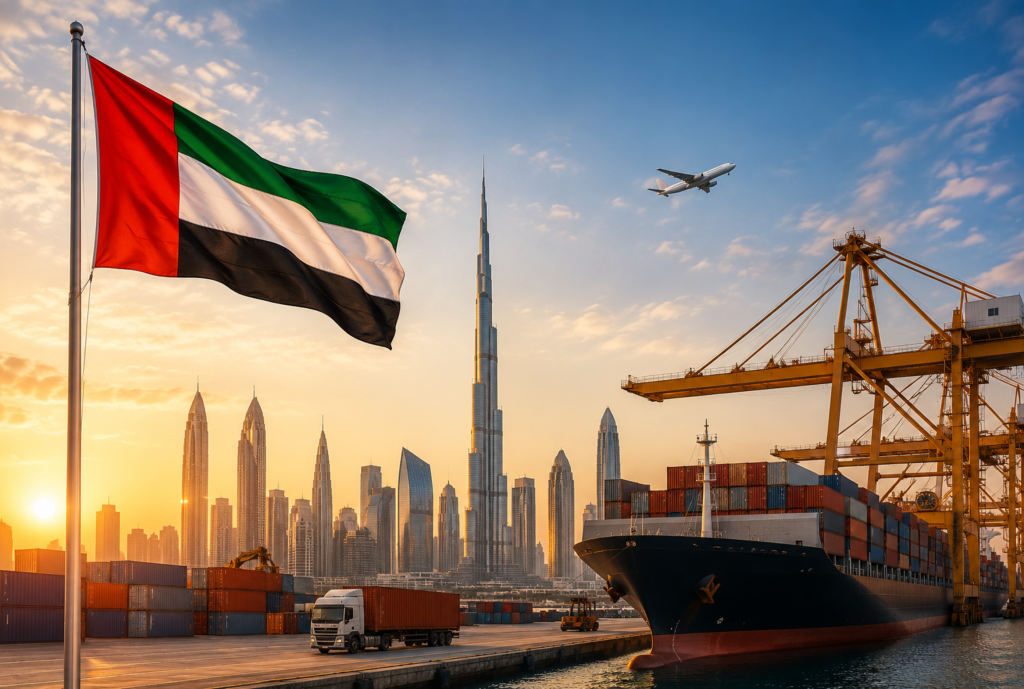
Trade data tells us where the market has been. Strategy determines who benefits from where it is going.
The UAE’s latest non-oil trade figures are more than a measure of economic performance—they reflect the country’s continued evolution as one of the world’s most strategic markets for international trade and investment.
H1 2026 highlights:
📈 AED 1.937 trillion in non-oil foreign trade (+13.1% YoY)
📈 AED 452.8 billion in non-oil exports (+23.9% YoY)
📈 Non-oil exports now account for 23.4% of total trade
📈 AED 304.3 billion in trade with CEPA partner countries
At Aims Global Consulting Services, we see three key implications for international businesses.
First, the UAE is strengthening its position as a value creation hub, not simply a logistics and re-export centre. Faster growth in non-oil exports points to increased manufacturing, innovation, regional headquarters, and higher-value economic activity. Companies should consider the UAE not only as a market to enter, but as a base from which to build regional operations.
Second, the UAE’s Comprehensive Economic Partnership Agreements (CEPAs) are delivering tangible commercial value. Reduced trade barriers, improved market access, and stronger regional connectivity create new opportunities for exporters and investors that understand how to leverage these frameworks strategically.
Third, businesses should rethink the UAE’s role in their international expansion strategy. The real opportunity extends beyond a domestic market of approx. 10 million people. With state-of-the-art infrastructure and connectivity, the UAE provides a gateway to the GCC, the wider Middle East, Africa, South Asia, and Central Asia.
For businesses considering expansion, the conversation is shifting from “How do we enter the UAE?” to “How do we leverage the UAE’s position to scale across multiple high-growth markets?”
Whilst the data also signals where the market is heading. The real differentiator will be how businesses respond. Organisations that move early, build strong local partnerships, and develop a clear regional strategy will be the ones best positioned to unlock the next phase of growth.