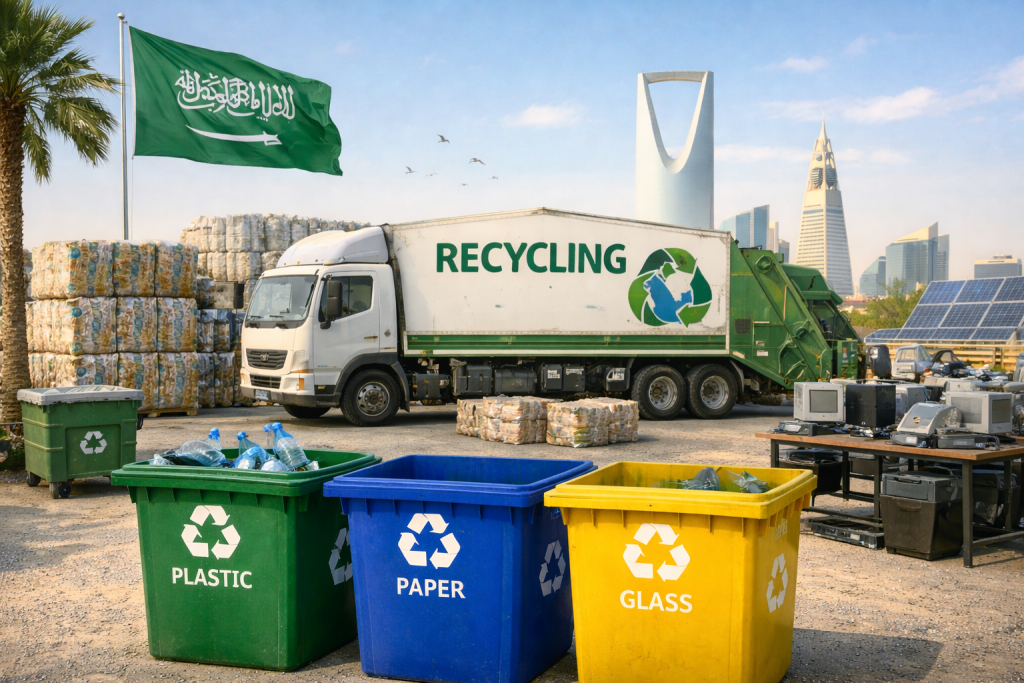
Saudi Arabia’s ambition to attract USD 10.7 billion in investment into its recycling industry by 2035 marks a decisive shift: waste management is no longer just a municipal function — it’s becoming a core industrial sector.
Through a new national licensing framework, the Kingdom has formally integrated recycling into its industrial ecosystem, covering eight activity areas ranging from organic waste and composting to hazardous waste treatment and metal scrapping. More than 230 companies are expected to benefit, creating a clearer, more investable market for both local and international players.
Why this matters now
This move aligns squarely with Vision 2030, as Saudi Arabia pushes sustainability, resource efficiency and industrial diversification. Targets to recover millions of tonnes of recyclable materials over the next decade signal a long-term commitment — not a pilot phase.
Crucially, regulation is catching up with ambition. Clear licensing, defined sub-sectors and government-backed entities such as Saudi Investment Recycling Company (SIRC) are reducing market uncertainty and accelerating scale.
What this means for service and solution providers
For companies looking to expand into Saudi Arabia, this is a market entering its build-out phase.
- Infrastructure & technology demand is rising – There is growing need for advanced sorting, material recovery facilities, composting systems, hazardous waste processing, and industrial recycling technologies.
- Digital and smart solutions are gaining relevance – As recycling scales, demand is increasing for data-driven waste tracking, automation, analytics, and optimisation tools, particularly where recycling intersects with smart cities and industrial zones.
- Expertise is as valuable as equipment – Beyond hardware, Saudi entities are actively seeking operational know-how, compliance support, plant design, EPC services and long-term facility management — especially from companies with proven international experience.
- Partnership-led market entry works best – Joint ventures, technology transfer models and collaborations with local operators or government-backed platforms remain one of the most effective ways to enter and scale.
The takeaway
Saudi Arabia’s recycling sector is moving fast — and at scale. For sustainability, environmental services and circular-economy solution providers, this represents one of the most commercially attractive recycling markets emerging globally.
The opportunity is no longer theoretical. The framework is in place, capital is earmarked, and execution has begun. For companies ready to localise, partner and invest for the long term, Saudi Arabia’s circular economy push offers both growth and strategic relevance.